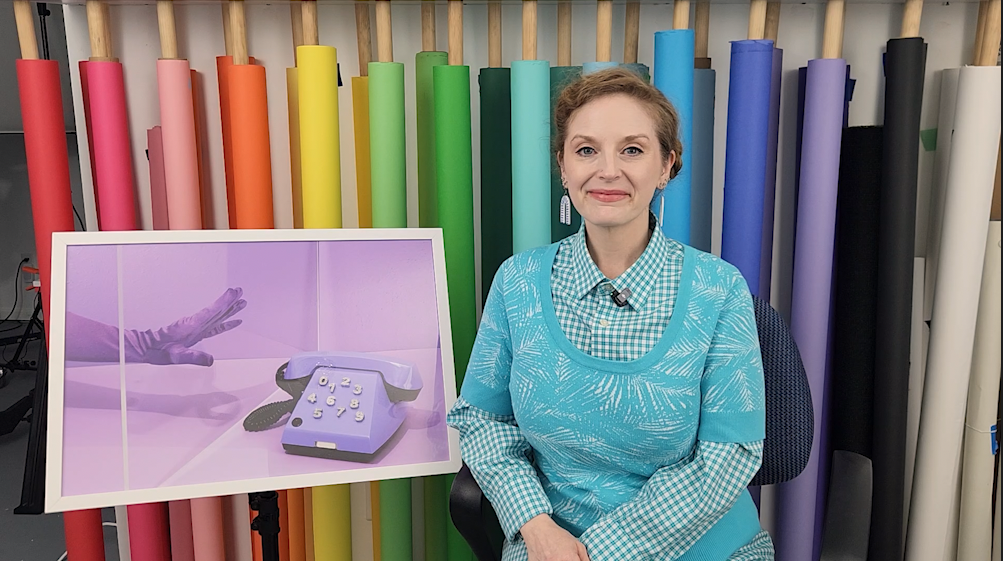
I have been working on becoming more visible. As artists we are storytellers and we share our work to connect with others. As an artist that lives predominantly in her head, learning to share my work and talk about it helps create a dialogue between myself and my audience, which is something I would love to foster.
But to create that dialogue I have to actually keep showing up on camera, which I really struggle with. I keep thinking about how we, as humans, were never meant for this much in your face time with your actual face. It wasn’t so long ago in human history, that you may have had a mirror, but for the most part you weren’t consistently confronted with your external appearance or the constant printed and digital images of other people’s faces.
The added layer of being autistic and masking or alternatively not masking, further complicates things, so showing up on camera, being visible and sharing yourself can feel overwhelming. Throughout, I kept my eye on the goal of creating a dialogue and connecting with others, that like me, are looking for art that explores being a late diagnosed autistic woman.
So to all the other artists and autists out there trying to get comfortable being more visible in whatever way you are trying to share yourself, I see you and am cheering you on!
Here is the transcript:
Visual Language: Making an Internal World Visible
I think in images.
I can see exactly what I'm trying to communicate visually before I can find the words to explain it.
I'm Jessiena Lake. I'm a photographic, stop-motion, and mixed-media visual artist, and my work uses color, familiar objects, play, repetition, and visual metaphor to explore experiences that aren't always easy for me to communicate verbally.
The Latest is an ongoing multimedia project about my experience of being a late diagnosed autistic woman.
Being awarded my autism diagnosis did not change the life I had already lived. It did change the way I understood it.The project developed into three interconnected kinds of images: Monochromatic Calibrations, Symbolic Still Lifes, and Release images. Together, they move through a process of grounding, expression, and release.
The Monochromatic Calibrations are about grounding myself.
I see the world through the rainbow. For these images, I collected objects from my life within a single color family and arrange them into detailed grids.
There is something grounding about taking a collection of unrelated things and creating a system for them. Making sense of a life, that doesn’t often make sense, in a simple, accessible way.A toy, a tube of paint, a spool of thread, a miniature camera, an item from my grandmother's craft supplies- they all belong together because they're from different parts of my life, can tell parts of the story of who I am and well because they are all pink.
Or yellow.
Or blue.
I photograph the completed arrangements, but I also use stop motion to record the process of building them. And the objects don't necessarily disappear when a Calibration is finished. Some of them, many of them, turn up again later in The Latest and its here they stay hidden like Easter eggs, making a game of the larger project.
That movement became important to the project. First I ground myself and then I can explore harder topics.
The Symbolic Still Lifes are where the project becomes more expressive. I use toys, games, handmade props, miniature sets, and familiar objects as visual metaphors.
In Guess Who, I use the familiar structure of the children's game to think about identity, recognition, and the experience of trying to understand yourself through categories created by other people. Who are you now and who do you want to be?
Other images use humor and symbolism similarily. I created these individual emojis because sometimes the most direct way for me to communicate something serious is through something playful.
I don't see playfulness and seriousness as opposites, I see them as complimentary.
Bright colors, toys, humor, and familiar objects can create an entry point into experiences that might otherwise feel difficult or inaccessible. A serious image might shut the viewer down, a playful image invites the viewer in. Similarly, creating only serious visuals would shut me down as an artist.
These objects already carry associations for the viewer. I can explore those associations, change their scale, change their context, or alter them in unexpected ways.
The third part of the project is Release.
These photographs deal more broadly with the things people say to you, that stick with you, in this case with words and phrases associated with internal and external ableism. The things that have been said to me, expectations I've carried, and language that stayed with me longer than it deserved. I chose 16 quotes and burned each one over 8 color waves in a thoughtful ritual, slowly burning each quote and layering the ash one on top of the other. Showing the accumulation and exploring why I had let it stay in my internal dialog longer than it was worthy of being there.
One of the phrases I released is, “I wish you hadn't told me.”
Previous viewers have thought I said this to my evaluator upon being awarded my diagnosis, but instead it was something that someone said that to me after I shared my neurotype with them. I held onto this quote , not because of who said it, but because of a fear it uncovered for me, that I wouldn’t be accepted for who I am and in releasing this quote, I realized I accept who I am and that was the real acceptance I had been searching for.
In the Release images, I physically alter the language. The photograph becomes evidence of that process of releasing their place in my internal dialog. The photograph is what remains. That is why these three forms belong together for me in exploring my life and my diagnosis.
Grounding. Expression. Release.
The Calibrations build the foundation.
The Symbolic Still Lifes allow ideas and experiences to expand through metaphor.
And the Release images make space for letting something go.
Using a multimedia approach through photography, stop motion, and the photobook also let me experience the work by exploring time in different ways, much like a late diagnosis does in your own life and experience of time.
A photograph captures a moment.
Stop motion expands that moment and brings the viewer into the experience.
A book creates sequence and asks the viewer to move through the work one page at a time, embedding stop motion in those pages brings those pages to life.
For much of my life, communication has often meant figuring out how to translate myself into a language and presentation that other people would understand.
Making The Latest has allowed me to explore a different approach to image making:
What happens if I communicate through my own visual language instead?
I began this project trying to explore an experience I couldn't always explain in words and didn’t have the language for.
But I realized when you think in images, like I do.
Photography can be your language.