A few weeks ago, I wrote about revisiting the self-portraits from my TONES series and finally understanding why I had been uncomfortable with the original photographs. I had spent decades masking, and some of that masking had made its way into the way I presented myself for the camera. When I recreated the portraits, I had stopped trying to arrange myself into something acceptable and I just felt comfortable. It was a relief showing up for the camera in that way.
Apparently the universe read that post and said, “Great. Let’s test that.”
I recently had two works from my ongoing series The Latest selected for It’s All Too Much, an exhibition with Excess Contemporary.
Excess Contemporary
October 1st- November 22nd, 2026
As part of the exhibition, Excess founder and curator Emily Cate Sabree invited participating artists to sit down for an on-camera interview. My first thought was that this sounded like a wonderful opportunity! My second thought was: Ohhhhh nooooooooo.
I have spent more than a decade professionally avoiding being photographed by being the person taking the photographs. It has been an excellent system.
Knowing Before I Go
As I wrote in In Conversation with My Photos, being autistic has always made being in front of a camera particularly uncomfortable for me. When I’m not consciously arranging my facial muscles into an acceptable configuration, my face doesn’t necessarily communicate what I’m thinking or feeling. Put a camera in front of me and suddenly I have several jobs: Where am I looking? What is my face doing? What are my hands doing? Am I smiling? Am I smiling too much?
An interview adds another job: say intelligent things while doing all of the above.
So when Emily told me she would send the questions ahead of our interview, I was thrilled.
I like to know before I go.
Having the questions beforehand didn’t mean scripting every word I was going to say. It meant having time to process what she was asking and think about what I actually wanted to communicate. Instead of spending the interview trying to formulate an answer while simultaneously being aware that a camera was recording me formulating an answer, I could arrive ready to have a conversation.
Preparation doesn’t make me less spontaneous or authentic. It creates enough room for me to be authentic, because I am still thinking- What am I suppose to say? Oh, no, I forgot what to say and now I am off on a tangent and how do I steer the ship back to the conversation? How do I give this person that is being so generous with their time usable sound bites? How to I share my visual communication system in words?
Getting In Front of the Camera
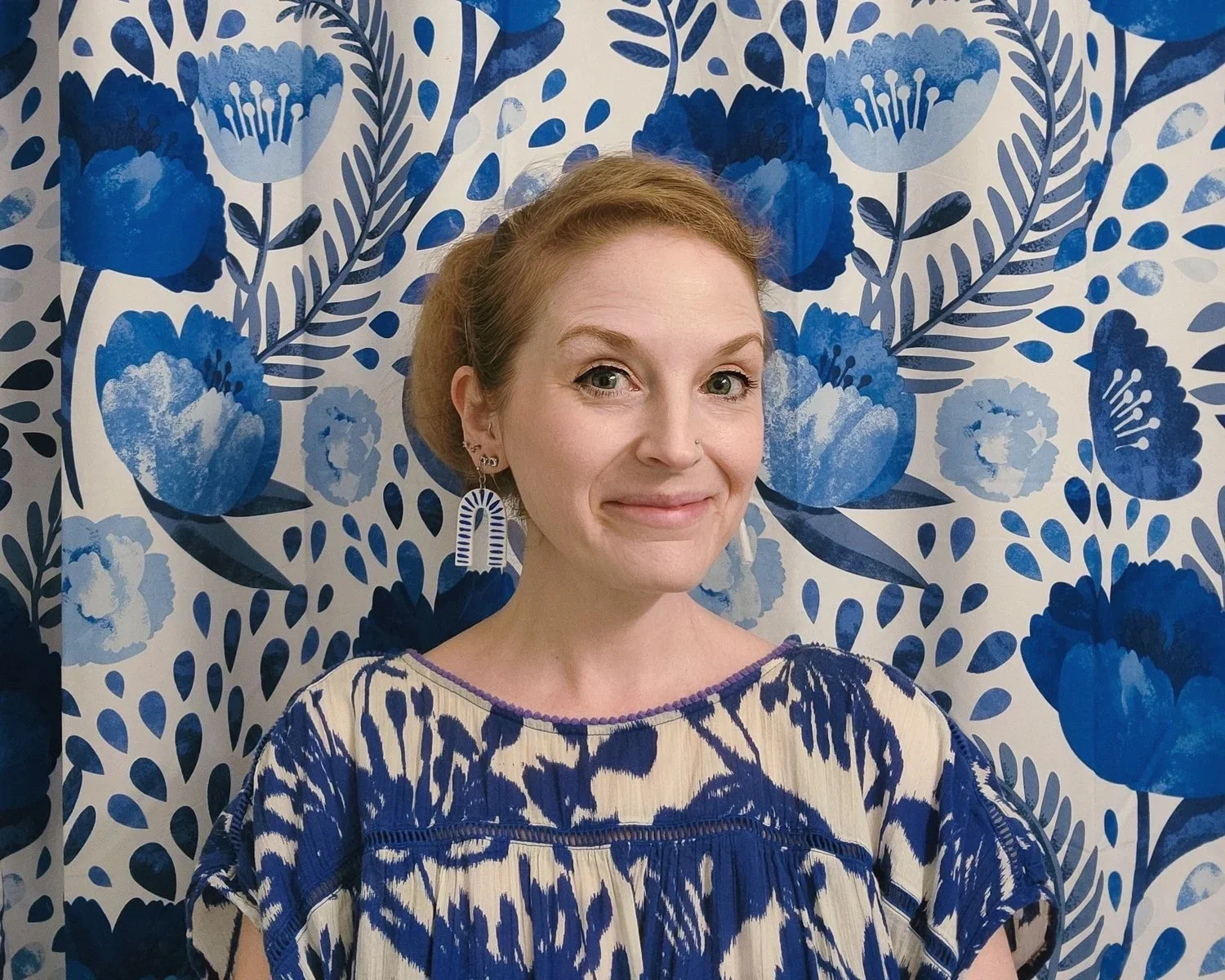
Of course, agreeing to an artist interview also brought another item to the top of my increasingly long art-career to-do list: I needed a new artist headshot.
Again: photographer.
My excellent system is failing everywhere at once.
When I recently remade the seven self-portraits from TONES, I finally understood that what bothered me about the originals wasn’t simply that I disliked being photographed. I was still masking when I made them, and some of that performance included presenting myself for the male gaze. Once I recognized that, I could approach being photographed differently. And in recognizing that kind of masking, I could name other types of masking I was doing for the camera.
So I approached my new artist portrait with some of the same thinking.
I wasn’t interested in creating Professional Artist Jessiena™.
I wanted to make a photograph that looked like me. Not what I am supposed to present as and I think I got pretty close to that.
And Then the Camera Turned On
After all that preparation, something funny happened when the interview actually started.
I stopped thinking quite so much about being on camera.
We talked about The Latest and the projects currently taking over our studios. We talked about what brings me joy in making art, the magical moment when something that has existed only inside my imagination finally appears in front of my camera.
But the conversation also wandered into much bigger ideas: arts access, autistic culture and communication, color, playfulness, community, and what art can do when we allow ourselves to care deeply about making it.
When Emily asked what “excess” means to me, I realized that I don’t necessarily see excess as excess at all.
What can seem like too much from the outside can simply be a passionate, vibrant, wholehearted approach to expression. Somewhere along the way, caring became cringe. Trying too hard became embarrassing. Effort needs to appear effortless. We’re supposed to care, but not so much that anyone can tell.
I love the effort. I love earnestness. I love the try-hards. I love people who care A LOT.
I am so not too cool for school. I am in the front row taking notes.
Maybe that’s part of why color and playfulness have become so important in my own work. Playfulness can invite someone into a difficult subject without making the subject itself less serious. Color can draw someone toward an image before they know what the image is asking them to consider.
And sometimes that invitation creates access.
We talked about the ways art spaces can welcome, or unintentionally exclude, people and what happens when art gives someone an entry point rather than requiring them to already understand how they are supposed to engage with it.
We also talked about autistic and neurodivergent communities and the cultural differences that can exist between autistic and neurotypical communication. I described it through the framework of culture: not simply different ways of speaking, but different expectations around communication, social behavior, and even the things one group isn’t doing that another expects.
And suddenly I found myself in exactly the kind of conversation I had been worried I wouldn’t be able to have while sitting in front of a camera.
Changing the Conditions
That may be what I’m slowly learning on both sides of the camera.
The goal isn’t to become more comfortable performing. It’s to create conditions in which I don’t have to perform quite so much and Emily and Excess Contemporary created the perfect set of conditions for that to be possible.
When I revisited my TONES portraits, that meant finding a way to exist in photographs without arranging myself according to someone else’s expectations. The relief I felt when I finally allowed the images to communicate through my interests, objects, clothing and color rather than relying on my face to perform was enormous.
This time, it meant making a new portrait that felt like me, knowing what we would be discussing, giving myself time to process the questions, and then showing up for the conversation.
And all that preparation didn’t make the resulting conversation less authentic, for someone who is autistic, it made the authentic conversation possible.
I still prefer my usual position behind the camera, It really is an excellent system.
But I’m getting a little better at figuring out how I want to exist on the other side of it too and what being visible looks like on the other side of the camera.